
Reducing Call Volume and Client Anxiety at IRCC

My Role
UX Researcher & Designer.
My main role was to conduct user research through interviews and data analysis, while also contributing to the design process. I focused on understanding user needs and collaborated with the team to turn insights into user-centred design solutions.
Background
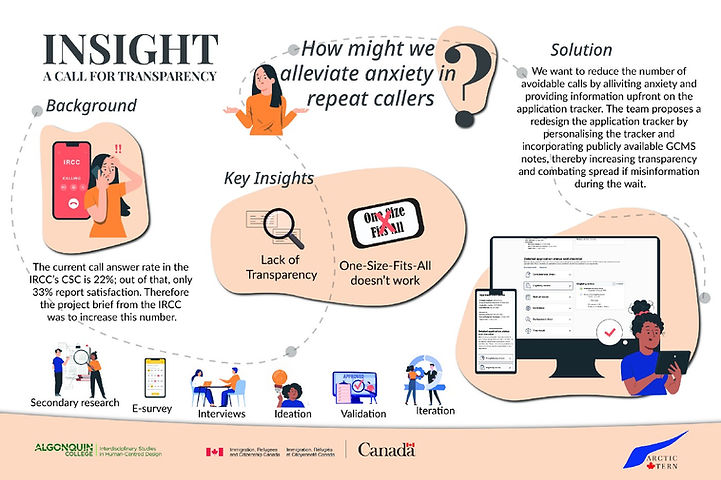
Increasing caseloads, file complexity, lack of resources, and limited call centre agent capacity led to longer application process times at Immigration, Refugees and Citizenship Canada (IRCC). This significantly increased the number of calls to their Client Support Centre (CSC), where only 22% of incoming calls could be answered. This created frustration and uncertainty for applicants, who often felt left in the dark about their application status.
Problem
IRCC sought solutions to reduce the call volume to their call centre and improve client satisfaction and trust in the system. To guide our efforts, we posed the question:
"How might we alleviate anxiety in repeat callers?"
Solution Process
Tools used: Google Forms | Excel | Miro | Figma
To address this question, we led and collaborated on the following research initiatives:
1. Secondary Research
We conducted a review of immigration trends in Canada and globally, analyzed the challenges of call centres, and studied IRCC clients' experiences with their services. This provided foundational insights into broader trends and pain points.
2. Survey Development
To gather quantitative data, we created and distributed a survey to 100+ clients. The survey explored their experiences with the application process, reasons for contacting IRCC, communication preferences, and overall satisfaction with support services.
3. Interviews
We facilitated 10+ interviews with users and subject matter experts (SMEs) to capture in-depth qualitative insights into client frustrations and system inefficiencies. These interviews highlighted specific challenges and areas for improvement.
4. Data Analysis
I synthesized findings and analyzed qualitative and quantitative data to uncover actionable insights that directly informed design decisions.
5. Concept and Usability Testing
We validated proposed solutions through iterative concept and usability testing with both end users and SMEs. This ensured the design addressed key pain points effectively and met user expectations.
Key Insights
After analyzing the data, two major insights were identified:
1. Anxiety due to lack of transparency
Applicants expressed anxiety over long wait times and the lack of visibility into their application status. This led to concerns that their application might be lost or forgotten.
2. Confusion from a 'one size fits all' approach
The uniform structure of the application portal created misunderstandings. Applicants often compared their timelines with others, leading to confusion and repeat calls to IRCC for clarification.
Artifacts


Design Intervention
To address these challenges, we redesigned the application status tracking portal with the following improvements:
1. Detailed Checklists
Breaking down the application status titles, which previously grouped several sub-steps, into separate titles and steps, providing applicants with greater clarity on their application progress.
2. Personalized Timelines
Displaying timelines tailored to each applicant's unique process, addressing the confusion caused by the 'one size fits all' approach and fostering a sense of trust in the system.
These changes empowered users with better visibility and confidence in their application process, reducing unnecessary calls and alleviating anxiety.


Outcome
Our research revealed that 48% of calls to IRCC were solely for application status updates. By implementing this redesign:
-
The call volume to the IRCC call centre could potentially be reduced by nearly half.
-
Client satisfaction and trust in the system could be significantly improved.
Deliverables
Here's what we created along the way:
-
Personas
-
User journey maps
-
Usability testing results
-
Research reports
-
Findings presentation